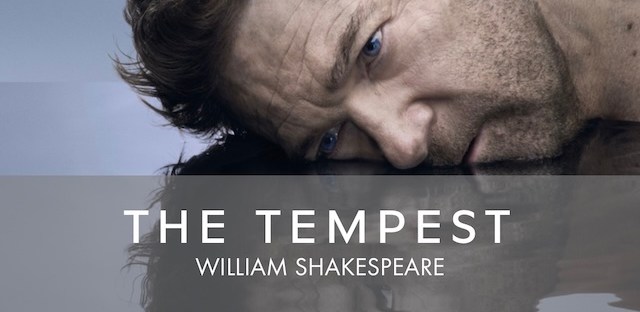
Sir Kenneth Branagh is currently starring as Prospero in Shakespeare’s play, The Tempest. The entire run sold out almost immediately which gives a great financial boost to the Royal Shakespeare Company, although I guess they must have put a few tickets aside for the King and his entourage as he popped in to watch it the other evening.
As we’re Bronze members of the RSC, Anne managed to procure us some hot tickets that got pretty close to our Ken, for one of the first performances, last Monday night. I was looking forward to it because I do like the play. It’s got magic, and romance, comedy and (spoiler alert) nobody dies.
There are lots of themes as well, that can be explored: how power can be corrupting; colonialism and slavery; whether to enact revenge or show forgiveness; the difference between nature and nurture, and much more. So, it has the power to potentially make you think.
If you’ve not seen or read The Tempest before then here’s an attempt at a summary:
A storm hits a ship, and it is shipwrecked upon an island. Amongst others, it contains the King of Naples (Alonso), his brother (Sebastian), his son (Ferdinand), his counsellor (Gonzalo) and the Duke of Milan (Antonio).
The storm was created magically by Prospero (previous Duke of Milan) who has lived on this island for the past twelve years with his daughter, Miranda. He’s still annoyed that Antonio, his brother, usurped his position and had him and Miranda cast adrift on a boat. It was partly because he was busy delving into the occult rather than administering to his city, but I guess that’s beside the point.
All the people on the ship are thrown off on different parts of the island by the spirits that Prospero commands, so that Alonso thinks his son is dead and likewise Ferdinand thinks the worst has befallen his father.
Prospero gets Ferdinand to meet Miranda (now fifteen) and they fall in love at the drop of a hat.
The spirits he commands assail Alonso and his group of nobles with crazy sounds and visions, while at the same time villainous Antonio and Sebastian plot to kill Alonso and his counsellor so that Sebastian can take Naples (when they get back of course).
Prospero has also enslaved a young man Caliban who was on the island before him. His mother Sycorax was exiled to the island years ago when she was pregnant with him, but she has since died. Initially Prospero treats him quite kindly and taught him their language, but when he assaults Miranda, Prospero reduces him to a very lowly slave to do all his grunt work.
Caliban meets the King’s fool (Trincolo) and his drunken butler (Stephano) who are also shipwrecked. They get him completely drunk and he thinks that Stephano might be able to overthrow Prospero.
Prospero brings them all together at the end and reveals himself for who he is. Alonso’s happy to have found his son and a new daughter-in-law. Sebastian and Antonio are forgiven but they don’t renounce their treachery. The ship is like new and all the crew are fine. Prospero has forsworn his magic and broken his staff and plans to go back on the ship with them.
The End.
So, to the play we saw. The press reviews aren’t out yet, but I’ve seen one or two reviews on Reddit who loved it and thought it was the best thing that they’d ever seen. Do I agree with them? Not so much.
Two of the most interesting characters in the play are Ariel the main spirit that Prospero commands on the island and Caliban. Ariel was a spirit that Sycorax had imprisoned in a tree for an unknown reason and Prospero had ‘freed’ to do his bidding. Ariel is never given a gender but more often than not I’ve seen them played by a female, as was the case here, by Amara Okereke. She appears on stage on a trapeze, that swings about gently and she sits or rolls upside down on it with skill. It could symbolise the spirit’s ability to fly and swoop, and possibly also her limitations under the thrall of Prospero.
The guidance in the text is minimal, but I love it when Ariel is played with an edge of surliness and spite, as someone who is stuck in servitude for several years might feel. Or conversely, given an overly bright, almost obsequious demeanour to Prospero but showing their venom with the likes of Caliban, as might happen with the stratification of slaves. Okereke’s skill on the trapeze was great, but I couldn’t quite discern anything more interesting about her.
All the spirits and Caliban were interestingly played by people who were not Caucasian. And Caliban had clothes that made me think of a plantation slave. He even did one of the songs to a tune that felt like it had an African beat (I’m no expert but it evoked an American slave folk song for me). The thing about Caliban is that, although he is often described in animal terms such as ‘monster’ and ‘fish’, he has some of the most lyrical and articulate lines of everyone. This is accentuated by the fact that he hangs out for most of the play with two drunken fools. Here’s he tries to lead his new ‘lord’ Stephano to Prospero so Stephano can kill him.
CALIBAN
Good my lord, give me thy favour still.
Be patient, for the prize I’ll bring thee to
Shall hoodwink this mischance: therefore speak softly.
All’s hush’d as midnight yet.
TRINCULO
Ay, but to lose our bottles in the pool,–
STEPHANO
There is not only disgrace and dishonour in that,
monster, but an infinite loss.
TRINCULO
That’s more to me than my wetting: yet this is your
harmless fairy, monster.
STEPHANO
I will fetch off my bottle, though I be o’er ears
for my labour
CALIBAN
Prithee, my king, be quiet. Seest thou here,
This is the mouth o’ the cell: no noise, and enter.
Do that good mischief which may make this island
Thine own for ever, and I, thy Caliban,
For aye thy foot-licker.
The dichotomy of Caliban’s physical appearance, his threat of violence and his eloquence is something that doesn’t often get highlighted on the stage, and it’s the same in this play. Ashley Zhangazha’s Caliban does not look like a fish or a monster. On top of that, the text says that Caliban is made drunk, probably for the first time in his life, by Stephano and Trinculo, which is why he is hoodwinked into thinking they could overthrow Prospero, but weirdly he spits the drink out in this play and shows no sign of being inebriated.
Caliban is a complex character. I wanted more complexity, more anger from this man, more drunken naivety, more confusion at these new people coming onto his island, more…just more I guess, but I couldn’t quite feel it.
I felt more was needed from the other characters too: I thought Sebastian and Antonio, who are painted in the play as out and out villains, needed more venom, and aside from a blink-and-you-miss-it snarl at the end, I didn’t see it; Stephano and Trinculo needed more slapstick; Alonso needed more grief; Miranda and Ferdinand needed more innocence; Gonzalo needed more clarity – unfortunately, he sounded like he didn’t have his teeth in. That probably wasn’t the case, and I apologise to Paul Jesson, but the character of Gonzalo has a lot of good lines about the beauty and wonder of the island and he is wonderfully optimistic. I just found it a little difficult to understand all that he said this time.
So, finally there is Prospero. The head honcho and Sir Ken himself. Now people will have different ideas about the type of Prospero they want to see on stage. Does he emphasise the Machiavellian conductor of proceedings to show the kind of power he can wield? Does he concentrate on his position as sole parent for his precious child? Does he wrestle between an old desire for revenge and a new maturity that shows clemency and forgiveness?
Branagh does begin the play by literally conducting the storm with a baton/wand from behind a music stand. He does get the laughs in the right place when he’s trying to make his teenage daughter listen to him. He is a commanding presence that you can believe in. But he plays it safe, and I get that. It’s his name that’s brought a lot of people into the theatre. People that might not normally come to see a Shakespeare play. They would want a clearly presented, straightforward narrative that they can follow, and I think it was that. I think that’s also why it was so short, as lots of bits have been cut out of the text; we were out and back at the hotel by around ten.
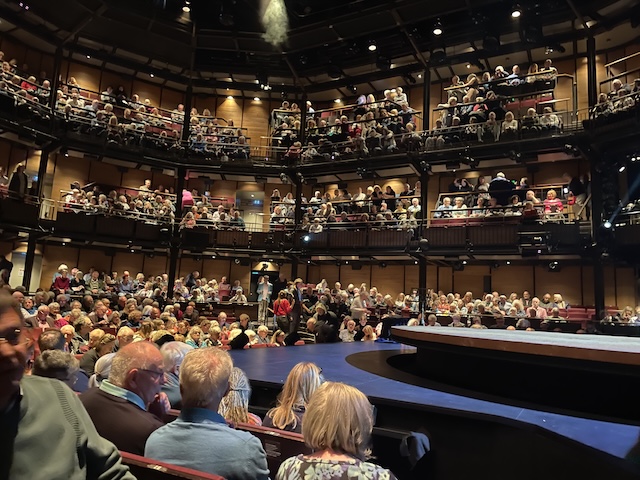
So that’s a good thing. A lot of people, not all by any means, gave him a standing ovation at the end. Probably the same ones that had clapped when he came on at the beginning. I’m sure for some of them, it will be their very first experience of Shakespeare. If they have a good time and come back again to watch another play, then he’s done us all a service.

