Ancient Greek myths seem to abound at the moment. On top of the raft of books re-imagining stories such as Pat Barker’s The Voyage Home, and Madeline Miller’s The Song of Achilles, there is, of course, Christopher Nolan’s The Odyssey, which I haven’t seen yet.
We could have gone to see it at some big IMAX while we were in London last week, but instead we opted for a play, The Oresteia. This was a modern retelling of a trilogy of plays by Aeschylus. I couldn’t quite wrap my head around how a modern version would work. The original had quite a heavy plot:
- Agamemnon (leader of the Greek army setting off to battle at Troy) sacrifices one of his daughters, Iphigenia, so that the goddess Artemis will sort the winds out for his ships to get going.
- His wife Clytemnestra is understandably miffed about the death of her daughter so when Agamemnon returns from the battle ten years later, she and her new man Aegisthus, kill him in the bathtub.
- Orestes eventually kills his mum to avenge the killing of his dad, aided by his sister Electra (if you’ve heard of Freud’s Electra Complex, this is where it comes from). Then there is a trial that stops all the revenge killings and moves ‘justice’ to the court of law.
So, a lot of death and very intense.
The modern version? A lot of death and very intense.
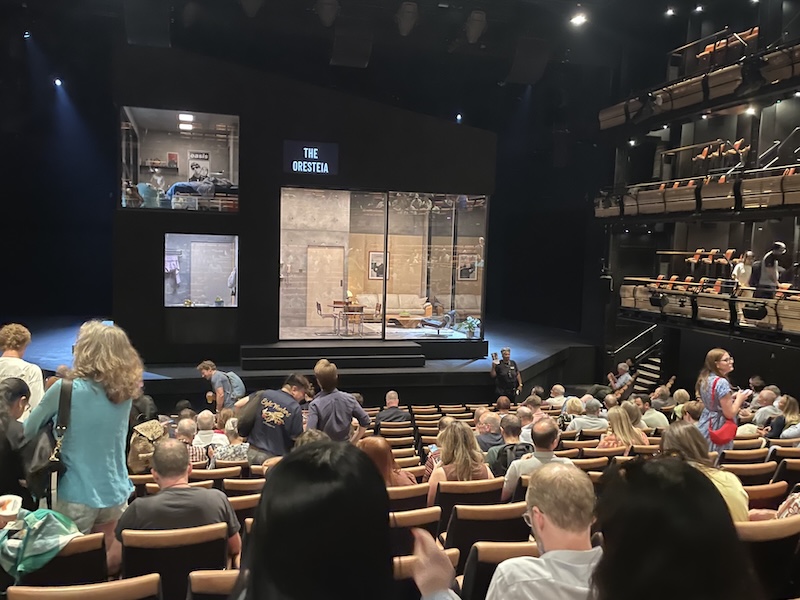
I was a little dubious around how the original death would happen in a modern-day world and whether it would have the same weight to generate the snowball of revenge that follows but I thought I’d give it a chance. The set was a revolving box of a house with lots of rooms including, ominously, a bathroom. It was a set that felt both revealing as all the rooms had glass and no curtains, and claustrophobic.
The first scene stamped from above as 2016, begins as a family that is seemingly happy and about to celebrate the twenty-first birthdays of the twin daughters, Alice and Isabel (they map onto Electra and Iphegenia). But immediately the cracks start showing. The first problem is that the dad, Christopher (Agamemnon) must work for a bit during the party, and the second is that Isabel isn’t at home.
Things begin to unravel at quite a pace. It’s a long play at three and a half hours, although thirty minutes of that is two intervals. It doesn’t feel long though because of the action. And there is a fair amount of jumping back and forth in time between events that occur between this birthday party and the present day.
It’s not too confusing but you end up seeing the effect before the cause and I was wondering why the wife Monty (Clytemnestra) goes from genial wife and mother to psychopathic killer. I didn’t find this out until the epilogue.
The pure, uncomplicated rage and revenge of the Greek myths can’t quite be neatly transposed to the modern day. There is alcohol to help the hand that holds the knife, and inferences to mental health problems and PTSD to explain the blood bath.
There is also, surprisingly for something so violent, a lot of humour. I laughed a lot. Perhaps because I felt removed from the characters, who were wealthy enough to think that Bollinger can only be used as cooking wine. It was also shocking in parts (there were audible gasp moments) and pretty gruesome, so a little bit of everything.
Ironically, the person I felt most sympathy for was David Morrissey’s Christopher. In this he’s not the gung-ho King who brings home Cassandra as his spoil-of-war sex-slave. He is a sad man with a gambling habit who feels sorry for the loss of his daughter, and after being separated from his wife, is subsequently with a kind, understanding woman called Chandra. I wasn’t sure what to make of this downplaying of the man as under the original circumstances, I’d be a hundred percent on Team Wife.
All the actors are terrific. I was swept up in this maelstrom with its humour and gore. If you go into the play without knowing much about the original myths upon which it is loosely based, I think it would still be a very entertaining ride, but it was fun making the parallels, some of which worked and some of which, like the original sin, didn’t quite hit the mark.
It was a superb evening all in all, and I was sorry that we had to dash before the applause had finished to get to our train. There was a matinee option but I’m not sure such a splatter fest would have worked in the day time.

