:The Remarkable Fellowship of C.S. Lewis & J.R.R. Tolkien
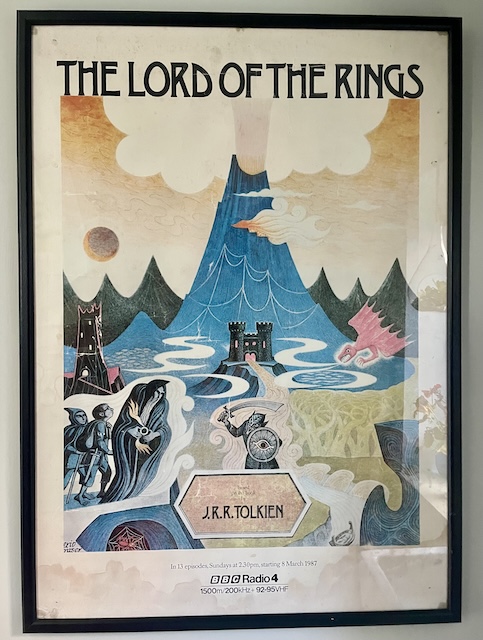
There is a poster on the wall in the downstairs toilet. It’s framed now but has the creases and watermarks from a long past and some rough handling. It advertises a radio serialisation of ‘The Lord of the Rings‘ by the BBC in 1987. When our three-year-old grandson comes for the day on Tuesdays he has begun to take notice of this poster whenever he uses the loo.
‘Is that a dragon?’
‘Yes, and his name is Smaug.’
‘Is that a bad guy in the middle?’
‘Yes, he’s an orc, and he’s definitely a bad guy. That big guy on the left is a wizard called Gandalf, and those little guys are called Hobbits. Their names are Frodo and Sam.’
Nannie Annie adds, if she’s taking him for a number one or two, that the dragon used to be ‘a bad guy’ because he felt lonely and didn’t have friends, but now he’s good. I’m not sure how to handle that major deviation from the canon but I hold my peace as it sounds like a tangential life lesson.
I remember clearly that I went to the library, when the series was finishing; I was thirteen at the time. I had read the books already, and watched the animated film, so the listening experience was an added sensory layer of absorption. It had disappointed me a little that so much was missed out of the adaptations – Tom Bombadil for instance. It was a life lesson for me to learn that films and radio plays had only finite space and couldn’t do full justice to the intricate world that Tolkien had built; even Peter Jackson couldn’t bring Tom in. I asked the librarian if I could have the poster when they weren’t going to use it anymore. I think she took it down there and then and carefully dabbed all the blue tac off the back before rolling it up and handing it to me. It has been one of my prized possessions ever since.
I have found a ‘new’ – it’s been going for several years – podcast (The Prancing Pony) and I’m listening to it from episode one as the presenters work their way through all the main works of Tolkien’s world chapter by chapter, beginning with The Silmarillion. So, I’m now doing a read along of a book that I haven’t picked up in over thirty-five years. Where did all the time go? I was a child that lived and breathed Middle Earth, tracing the contours of its maps and learning the runic alphabet enough to write the subject names on my exercise books to the bemusement of my teachers. I never delved deeper into the actual languages he created – I knew my strengths, and learning Elvish was not one of them. Now I come to the books accompanied by adult American men who are in a different league of nerdiness to me but I’m loving being drawn back into that world.
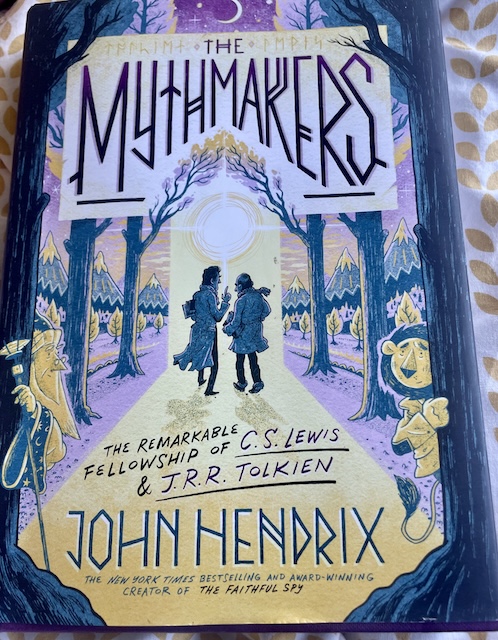
Recently a comic shop has opened in our town of Bebington, called Kraken Comics. Anne, who follows stuff on Instagram, bought Mythmakers from them, and I read the whole thing in a day. The visual side of the enterprise is a little wasted on me; my eyes skated over the artwork in a superficial manner, in the same way that I took in all the invented languages of Tolkien’s world. I’ve only read a few graphic novels: two by Alan Moore and more recently ‘Maus‘ by Art Spiegelman. I enjoy the pictures, and I think it adds to the narrative, but I suspect I miss the small extras that the artist might put in, which I’ve been told they do.
I had known that Tolkien and C.S. Lewis knew each other but I didn’t know just how seminal they were to each other’s works. In fact, as enamoured as I was by Tolkien’s Middle Earth when I was young, I didn’t know a great deal about his life, or Lewis’s, so the book is a great introduction to the two men. Both were born before the turn of the century, both went through the horrors of attrition on the Western Front, and both read and taught in Oxford which was where they met and formed the Inklings.
The book’s primary concern is their relationship with one another. From that initial fraternity, they formed a close friendship that helped to fire and encourage the creativity of each man. Over time, however that deep bond deteriorated into a slow separation. Their faiths played a part in this: Tolkien had an unshaken Catholicism with its centuries’ old doctrine and ritual; Lewis jumped on his re-discovered Anglican faith with the zeal and questioning that Tolkien found difficult to comprehend. Their personalities were also markedly different, and this was reflected in how they approached their writings. One slowly built up his world using the invented languages he loved to create as the skeletal underpinning, in order to create a multiplicity of histories, cultures and beliefs. The other dashed off adventures with speed and wove in very explicit Christian allegory into most of his work.
Despite these differences, however, the book suggests that the two men were integral to each other’s early development as writers. I thank them both. I read the Narnia Chronicles at a much earlier age than ‘The Hobbit‘ or ‘The Lord of the Rings‘. Call them my gateway drugs into fantasy, although to be fair, it had me at Enid Blyton’s ‘The Folk of the Faraway Tree‘. The Narnia stories are more accessible but less sophisticated, perfect for younger readers. I didn’t pick up on the allegorical message at the time, what with being a Hindu and all, but I loved the travel from our world to another, the talking animals, and the adventure.
There is a possibility that the lamppost in ‘The Lion, The Witch and The Wardrobe‘ was inspired by a lamppost that still stands here in Bebington. Lewis was extremely friendly with the Lancelyn-Green family and visited them here. In the grounds of St. Andrews, the church he would have attended with them stands a lone lamppost. It has not been categorically confirmed or denied but I have seen this lamppost in the winter time surrounded by a blanket of snow.
 theleadlesspencil
It has to be ‘The Folk of the Faraway Tree’ for me every time – and all of Enid Blyton’s fairy tales. That Amelia Jane is one bad ass doll!
I coped with ‘The Lion, the Witch and the Wardrobe’, but only as a bedtime read to Bobby when he was still just young enough. Tolkien leaves us cold in this house. The only thing of his I’ve ever read is his translation of ‘Sir Gawain and the Green Knight’. And Simon Armitage’s version is miles better.
‘Lord of the Rings’? Sorry, I just don’t get it. But I’m probably in a minority and I enjoyed your piece about it – but you’ve clearly got the posters in the right room 😂😂😂😂
I’m not entirely sure if I can talk to you anymore 😂😂😂
It’s the end of a beautiful relationship.
Oh go on then, we can still hang out. We just won’t talk about elves and hobbits
If we stick to Moon Face, The Angry Pixie and Dame Washalot, we’ll be fine.
I have a friend whose research leads him to believe that the geography etc of The Lord of the Rings was inspired by Faringdon. Apparently there were old locals who remembered the ‘Old Professor’ who often visited from nearby Oxford. Another friend had wallpaper removed from a house in the area where the Professor stayed and apparently there were drawings and writings on the wall beneath – that the decorator painted over!
Oh wow, what a claim to fame. Which part of Middle earth is it? The Shire or Mount Doom? 🤔
Thinking is that, in particular, the Folly Tower might have inspired Saruman’s Tower at Isengard – but no doubt he took bits from many different places. https://www.faringdonfolly.org.uk/uploads/1/4/0/4/14041893/tolkien_and_the_folly.pdf
That’s a fascinating read. Also includes Warwick Castle near my home city of Coventry.