I know I shouldn’t, what with the crumbs and all, but I’m eating a pain au chocolat on the bed with a glass of red to wash it down. It’s a moment of decadence that I can enjoy while we relax, before watching our second play in two nights. And luckily, it’s not my bed.
It can sometimes feel intense watching two plays in a row, but the double-whammy means that we can take a bit of time to immerse ourselves in Stratford upon Avon and make the trip a mini-break. Having said that, I was very sad to find out that the local Premier Inn has had a makeover and got rid of virtually all the baths. It was the only reason we choose to stay here. That and the really comfy bed. That and the comfy bed and the fact that we can park for free right underneath.
But really, it was mainly the bath, so all other accommodation that I can explore from anywhere other than AirBnB, is now fair game.
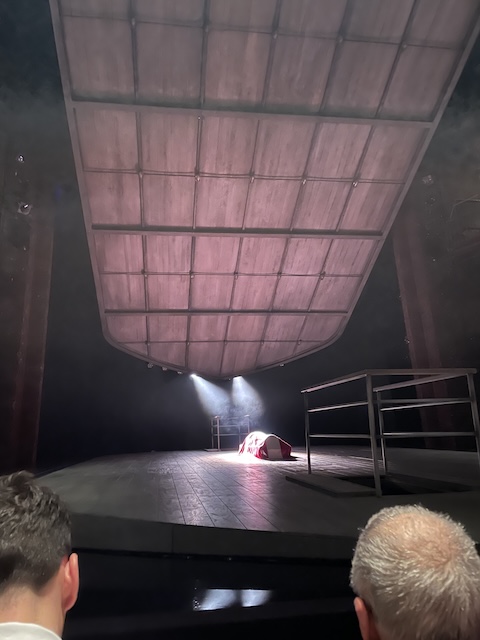
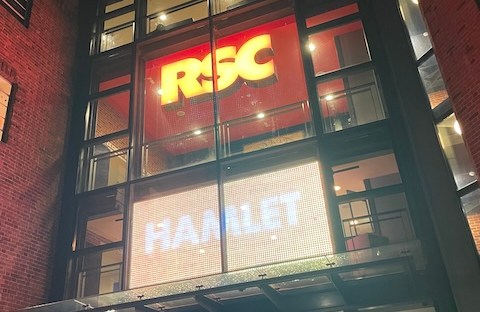
Intense is how I would describe last night’s Hamlet. Intense, and on occasion, nauseating. Not because of the blood, skulls and sheer number of deaths that occur in the play, but because of the set design. For this version of Hamlet, Elsinore was a ship, and an oft pitching ship at that.
Technically it was very clever, the video-scape of the moving waves at the back gave you a real sense of movement, and the stage was in the shape of the bow that was virtually always on a bit of a slant but lurched almost vertical every now and again to mirror the tumult of the scenes. Its confined space added a claustrophobia to an already angst-ridden play. The closing in of boundaries is compounded by a digital clock on the side which reduces the whole time-dimension to just one night.
Hamlet is Shakespeare’s longest play, and on top of that the main character, the young man-boy Hamlet, is given the most lines to say. The plot summary goes something like this:
- Young Hamlet is somewhat glum after his uncle Claudius has just married his mum Gertrude because it is less than two months since his own father, also called Hamlet, has died.
- Old Hamlet, as a ghost, tells young Hamlet that he needs to be avenged because Claudius killed him by pouring poison down his ear while he was sleeping.
- Young Hamlet hates his uncle anyway, and is starting to hate his mother, and developing a bit of misogyny to all women because of it.
- Young Hamlet (YH) has a bit of a conscience which paralyses his attempts to act on his dead dad’s words. What if it’s not his dad? What if it’s the devil?
- He pretends to go mad to try and gather evidence against his uncle and buy himself some time.
- A group of travelling actors put on a play that YH has had a hand in amending. He makes sure everyone is in the audience. In the play the King is killed with poison in the ear and watching Claudius’s reaction he decides he is guilty and decides to act.
- He can’t decide whether to kill himself or kill Claudius – the ‘To Be Or Not To Be’ speech is a soliloquy where he contemplates suicide.
- He is also horribly mean to the young woman he’s kind of seeing, Ophelia, and accidentally kills her dad (Polonius). Then melodramatically declares he loved her deeply after she dies (probably a suicide).
- The final act is all action, where YH duals with Polonius’s son Laertes who has returned to avenge his dad in a timelier manner than YH has shown. Claudius who has been plotting to kill his nephew/stepson ever since the play and convinces Laertes to put poison on his sword. There is also poison in the refreshment wine. After much mayhem, where Gertrude accidentally drinks the wine, and YH, Laertes, and Claudius are cut with the poisoned sword, everybody dies.
The first few acts show how Hamlet agonises over the trauma of grief for his father, followed so soon by the marriage of his mother to his uncle. He soliloquises a lot. The play is an existential minefield, and whoever plays the lead has to be able to convincingly traverse adolescent mood swings with great philosophical thought. They must convince us that they are dropping into insanity, albeit as a ruse … but is it?
The other thing every Hamlet has to do, is to speak words that are in Shakespeare’s greatest hits of lines, and to speak them afresh.
‘To be or not to be’; ‘Sleep perchance to dream’; ‘Alas poor Yorick I knew him Horatio’, etc, etc. These can quite easily sound trite, but Luke Thallon seemed very convincing. I don’t think I have seen Hamlet live before, although I’ve seen a few versions on film. I would put this up there with the likes of David Tennant, and that was a high bar.
He was supported by a very good cast. Anton Lesser played the ghost of his father with a suitable charismatic gravity. Ophelia, played here by Nia Towle, can sometimes come across as a bit insipid, but here seemed to have more backbone. Gertrude and Claudius also seemed more fleshed out, with their own agency.
The pitching of the ship reached a slightly excessive crescendo with the final ‘everybody dies’ scene, but aside from that, I thought the play was excellent, and I’ll be watching out for Mr Thallon in the future.
Postscript: For the second play, Edward II, we got as far as Act I, Scene I, and then, after a crash where a platform fell over (and hopefully no one was hurt) they had to cancel the play! We were really disappointed and had to console ourselves with a bottle of Sancerre in a pub. According to my friend Robert who’d seen it on Monday, it was excellent.
 theleadlesspencil
I was shocked to read your Insta post just after the collapsing stage incident at ‘Edward II’. I also hope no one was hurt. I’m also sorry you didn’t get to see the entire play.
It was, indeed, excellent, from the moment you entered the auditorium before the play began and were invited to process before the catafalque of Edward’s father, Edward I (Edward ‘Longshanks’), to the terrifying horror of Edward’s infamous murder at the end.
I didn’t realise until afterwards that the actor playing the eponymous lead, Daniel Evans, is also Co-Artistic Director of the RSC, and a Valleys’ boy from South Wales like me. He is superb: he uses his beautiful voice and captivating eyes to achieve amazing stage presence. He conveys Edward’s feelings for Gaveston with total conviction and credibility, as well as his torment at the limitations of his royal power to choose whom he may love. Whether Gaveston reciprocates with the same sincerity is something that Marlowe, I think, leaves up to the actor and his director but, in this production, Eloka Ivo seems not to be using his royal lover just for his own interests but displays genuine affection.
Evans plays Edward’s final tortured scenes in the waterlogged dungeon with huge pathos; and, as always, the audience is left bereft and in shock at the brutality of his death. However, the swiftness and decisiveness of his boy-heir’s vengeance on his father’s enemies makes for a very satisfying and cathartic ending to the play. It also prefigures the great renown Edward III will bring to his long reign as arguably England’s most successful King.
Throughout, I kept hearing lines I had memorised exactly 40 forty years ago in order to answer questions on ‘Edward II’ in my English A Level in 1985:
The griefs of private men are soon allayed,/ But not of kings.
There is a point to which, when men aspire, they tumble headlong down.
Because he loves me more than all the world.
Oh, I wish I had seen it, and yes, I too hope no-one was injured. We were toying with the idea of shooting back one night, but we’ve got too many other things on. I don’t know Edward II at all, and I’m quite impressed at Marlowe’s freedom to write about homosexuality in Elizabethan times. I think the English got a bit more buttoned up later perhaps.
This is a brilliant novel which impressively combines the mystery over Marlowe’s death and the ending of ‘Edward II’ in Historical Novel 2024. You probably need to know the end of the play to get the full significance of the novel’s title and plot.
Buy Lightborne: A Times Best Historical Fiction Book of 2024 Main by Phillips, Hesse (ISBN: 9781805460398) from Amazon’s Book Store. Everyday low prices and free delivery on eligible orders. — Read on http://www.amazon.co.uk/Lightborne-Times-Best-Historical-Fiction/dp/1805460390
I’ve made a note of it. I have essential reading after The Odyssey – incidentally, I was going to compere Telemachus to Hamlet somehow in my blog, but then I forgot the how – going to tackle Ulysses next 🫣
… and I thought two skiing holidays was decadence. Well beaten by a pain au chocolat on the bed with a glass of red, to say nothing of the bottle of Sancerre.
Ha, hardly Vince! But I have to get my pleasures where I can!