
I stood up close to a section of the makrana marble and tried to block everything else out. The thousands of painstaking hours required to shape the green, red and black stones and lay them into the ivory-white with such perfect precision is breathtaking when you think about it.
A love story it is said. I’m not sure if Mumtaz felt the same way being, as she was, in an almost constant cycle of pregnancy and childbirth. They were married for nineteen years until she died trying to push out their fourteenth baby.
Shah Jahan’s grief, however, gave rise to one of the modern wonders of the world, and I imagined what it was like for him to walk through this building and the grounds around it. He would have stood alone, save for some retinue, perhaps.
Unlike me. I’m joined by masses of other visitors, shuffling along in a noisy, untidy queue, passing in and around the internal domed hall where the tomb of Arjumand (later given the title Mumtaz Mahal) originally rested. She and Shah Jahan were later buried in a lower room in this same building, but copies of their tombs remain on this ground floor.
Despite the crowds, which are always large but inflated now because of the holiday period, I don’t regret the flying visit to this magnificent building. For small moments I can still imagine that the cool, polished walls I touch, were also touched by the emperor in quiet contemplation of his loss. I could still marvel at the calming symmetry of the whole complex, where the only thing out of place is Shah Jahan’s own tomb which is placed to one side of his wife.
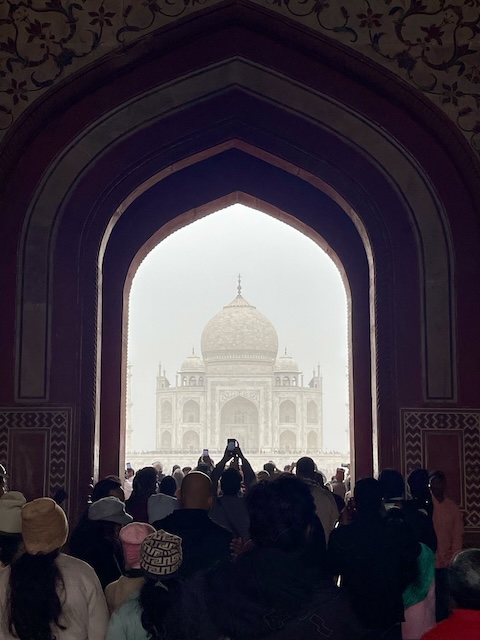
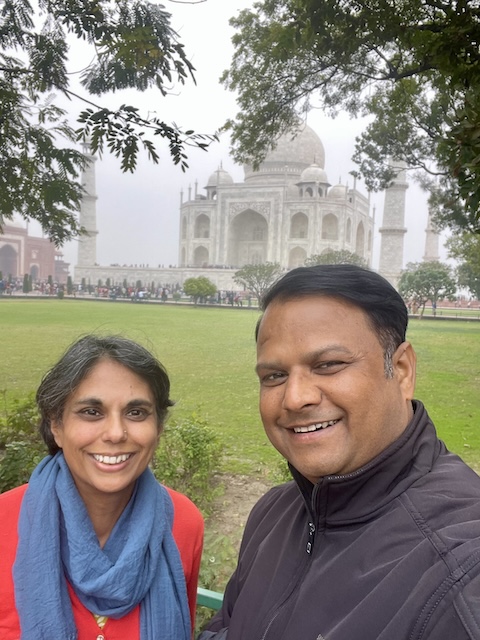
The queues were so long though, and without Rocky, my guide, I think I’d still be waiting to get in. I don’t know if this is what his mother named him, but he introduced himself as Rocky when my driver picked him up on the outskirts of Agra. My driver called himself KK and had picked me up at Delhi airport just over three hours earlier at eight in the morning. It had been a long drive after a two-hour flight, but for the most part, we’d zipped along at a decent pace along the Yamuna Expressway, named after the snaking river that flows past Delhi and Agra.
I had thought long and hard about this short visit to the Taj Mahal because it didn’t come cheap, was in the height of the day, and was a crazy long way to go for just a few hours. However, I’ve no idea when, or if, I’ll next come back in this country, so I took a punt.
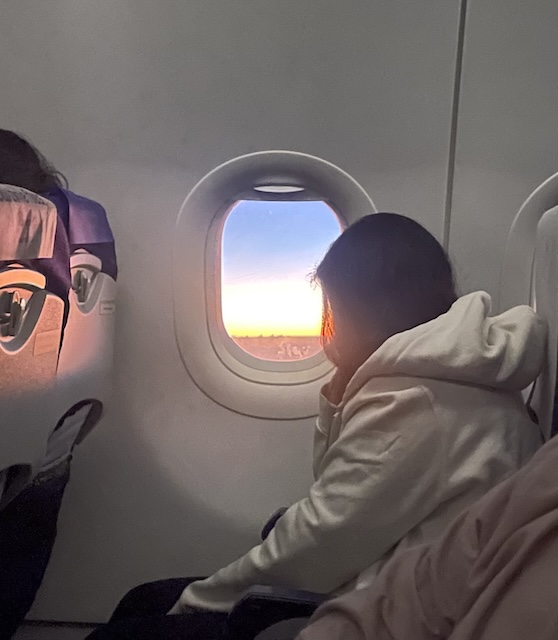
Waking up early for the run on the Sunday morning was supposed to help me begin my Monday adventure. But I didn’t get more than three hours of sleep for some reason. If my Garmin could have given me a readiness score of zero, I think it would have. Feeling like a zombie, I managed to make my way to the entrance on time and my driver on this side, Rahim, was waiting outside at 3:45 am promptly to take me to the airport.
All the drives and the flight each way were straightforward, and I even got to sample some chai in a disposable clay pot when KK stopped at the service station midway. He insisted it would be better than the Mumbai chai, and I didn’t tell him that I couldn’t taste the difference.
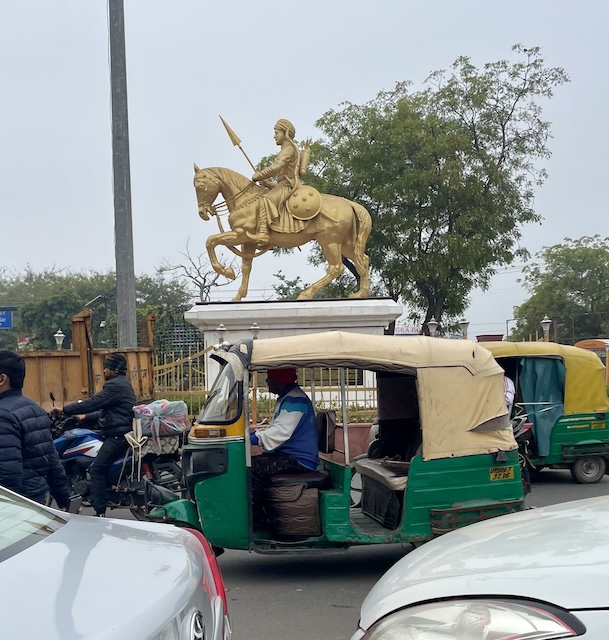
Right outside the Taj complex entrance, a statue has stood since the summer just gone, of Durgadas Rathore. He fought off an attempted land grab by Aurangzeb, the son and eventual jailor of Shah Jahan. Outside the Agra fort is a statue of Shivaji. He, to all intents and purposes created the state of Maharasthra, by making his own land grabs, and at times working with, or against Aurangzeb. Both statues are Hindu.
To me they feel like a political act, and it seems a bit cheeky, given just how much money the state and national government make from all the thousands of visitors, to slap these Hindu figures outside historical Mughal Muslim places. Especially as neither figure had anything really to do with Agra during their lifetime.
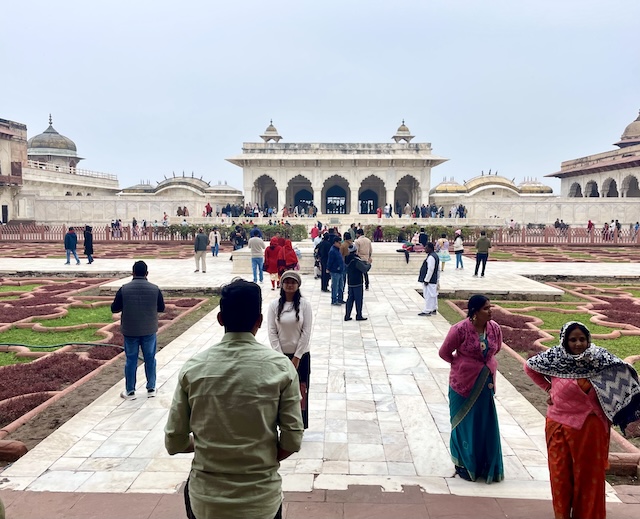
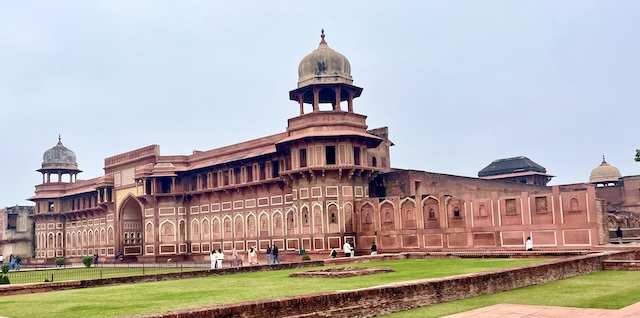
The amount of money generated by the Taj and the Agra Fort must be huge given that there are zero restrictions on how many people are allowed to enter. Again, like with Elephanta Island, you have to wonder what happens to the money. I found an article in the Times of India from 2019 saying that over a three-year period, the income was roughly twenty million pounds, of which less than one and a half million was used on conservation and maintenance.
There is so much more that they could do with the Taj complex with just a little more of this money. One of the side buildings was a guest house where the emperor and others spent some of their time during the day (as no one stayed overnight apparently). How amazing would it be to recreate the tapestries and furnishings there would have been, in one part of the guest house, to allow people to visualise this historical time a little more tangibly. As Agra is no longer allowed to have any factories other than small handicraft centres using old methods, then this would be the perfect place to use them.
If they limited the number of people and put them into two-hour time slots, it would allow for a more enjoyable experience. It would still bring enough people in make a tidy sum and might even bring them back again.
I’ll get off my soapbox now and finish off by saying that my twenty-two hour round trip to the Taj Mahal was worth it, and my readiness score is back up to fifty-four and so I’m almost fully recovered.
 theleadlesspencil
So no chance of a ‘sitting on my own like Diana’ moment?! Still, as you say, a trip of a lifetime.
‘That’ bench had an even bigger queue than the entrance!!
Another monument to an iconic dead woman