
Well, so much for a blog a day, this is only the third one and we’re already into the second week. It’s New Year’s Eve all of a sudden. But that’s okay, it’s been a great experience so far, and I will get to writing about it all eventually.
There is a small building before you get to the Gateway of India, where you are supposed to get your bags checked. We dutifully put them onto the conveyor belt, but there wasn’t anybody there to monitor the screens so who knows what might have gone off the land that morning. This was at around nine o’clock when the jetty in front of the Gateway was teeming with small ferry boats waiting to take people to the nearby Elephanta Island.
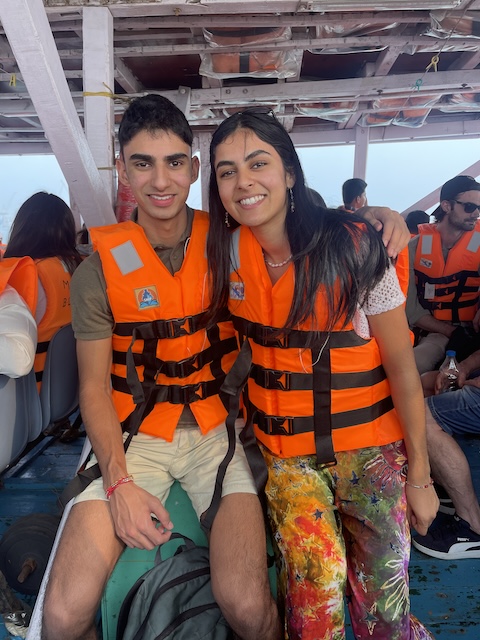
The week before our trip there had been a bad collision between one of these ferries and a naval boat causing many deaths and injuries. It’s not clear yet whose fault it was, but the ferry had been overloaded to begin with. So, this time the top deck was out of bounds, and we were all asked to put on life jackets. We had picked a particularly hazy day to take the trip which meant that we weren’t losing out on the views by sitting below.
Elephanta Island is so called because, in the seventeenth century, the Portuguese, during their early colonising exploits, found a large statue of an elephant on the shore, below the caves. This sculpture subsequently fell and broke apart after the British tried to take it back to England but is now restored and in a Mumbai museum. So aside from one or two reliefs of the Hindu god Ganesh, there are no elephants on Elephanta Island.
The locals call the island Gharapuri, meaning ‘the city of the caves’, and it has been inhabited since at least the second century BCE, although the cave art is around fifteen hundred years old.
From where we landed, there was a small train available to take some people to the foot of the steps leading to the caves. It’s a long flat jetty that you can easily walk but the train is a tad faster and there were spaces, so we jumped on it.
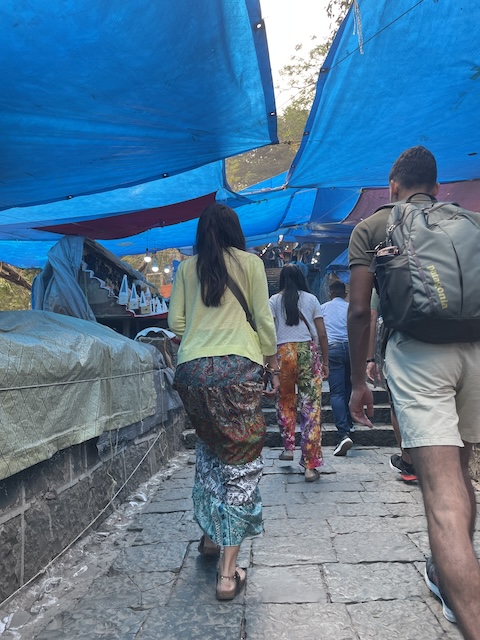
At the base of the steps, there is an option to be carried up in an open top sedan chair for a reasonable price. I didn’t see any takers this time and I’m not sure how it would have worked in some sections where the pathway through the many vendors is quite narrow. Some of these stalls were still setting up as we climbed the 120 steps. We were probably among the first groups for the day, although that didn’t mean that it was nice and quiet!
Avinash, our guide for the morning (whose details Hersha had found on Trip Advisor), was born and brought up on this island. He only left when he went to college. He probably knew the caves inside out even before he began offering his services, and he was aware of every bullet mark in the carvings which the Portuguese had made during their time here, when they’d used them for target practice.
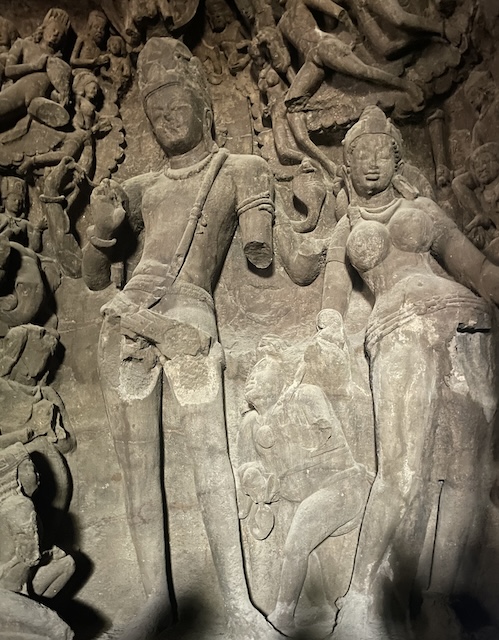
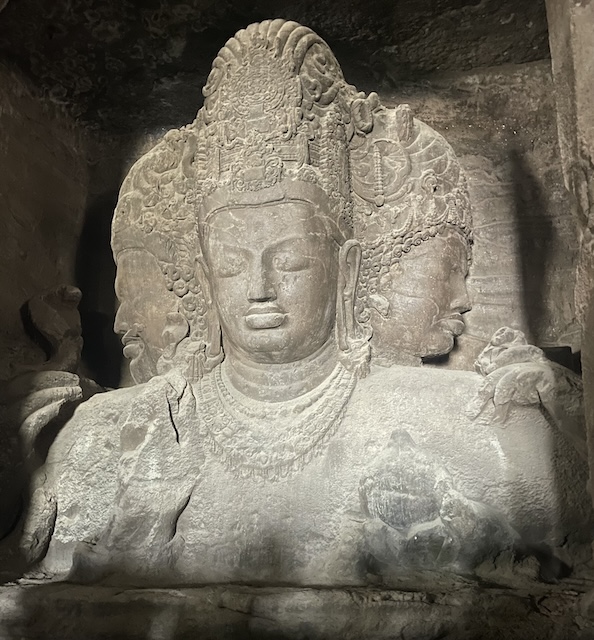
The statues and reliefs all depict episodes from the tales around the Hindu god Shiva. Like the one where the demon Ravana tries to lift Mount Kailash, where Shiva resided, from the Himalayas down to his land in Sri Lanka. Shiva, using just his big toe, traps Ravana beneath the mountain for a thousand years. As you do.
Historically of course, these caves were a place of worship, but when the Portuguese came upon them, they had been abandoned. Now, thousands of tourists come each week, and therefore, it can be assumed, a lot of money is generated. But the complex outside of the caves is somewhat ramshackle, and the loos are awful. Avinash showed us one of the villages nearby, and that too is made up of rough and ready looking houses. We didn’t get the chance to ask him as to where he thought the money generated from the tourists might be going, but wherever it is, not much of it is here.
When we returned the mainland, the crowds making their way to the ferry boats had increased exponentially. It had been a very good call to go early. We used the facilities at The Taj Mahal Hotel because they are plush. We were also hoping to have at least a drink there but at that time of the day it is packed because it is so close to the Gateway and the ferries.
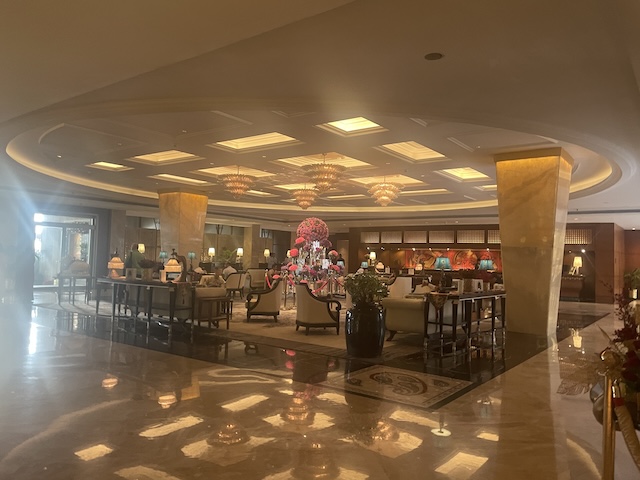
There is a belief that the founder of Tata Company, Jamsetji Tata, built this hotel when he was snubbed by the owners of another hotel, Watsons, because he wasn’t a European. It’s probably not true, but Watson’s, having later been turned into private apartments, is now in a marked state of dilapidation whereas the Taj, after its own ups and down, seems to be going pretty strong.
The Tata family is Parsi, part of the Zoroastrian community that left the Persian lands centuries before, when Islam was becoming the dominant religion. A lot of them settled in Gujarat, and Jamsetji was born in Navsari, the same city as both my mum and dad, as it happens. Many of the Parsis rose up with the British because they accessed the education that was opened up for non-priest castes, and because they were neither Hindu nor Muslim.
During our second guided walk later in that evening Kushaul, our guide, pointed out one example of an ‘agiary’ a temple of fire, in an area that historically, had no Hindu or Muslim places of worship.
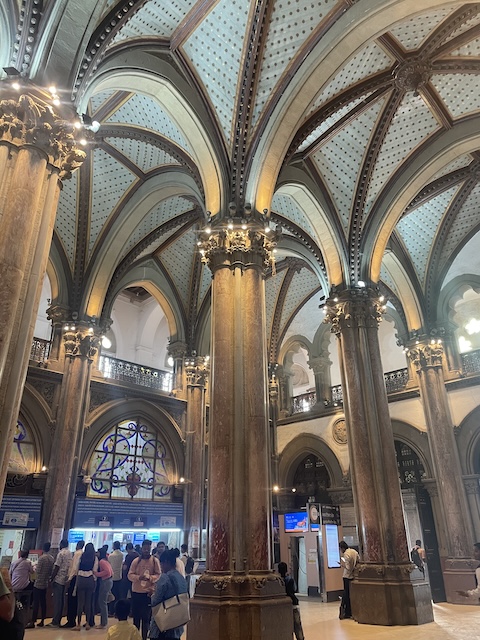
He’d arranged to meet us outside a Vada Pav shop by the very beautiful railway terminus. I kicked myself because we’d literally just finished a late lunch at a lovely quieter café in the street behind the Taj, but it all smelt very tasty.
Vada Pav is Mumbai’s burger of choice and massively popular amongst locals. It’s made up of a slightly toasted well-buttered white bread roll filled with a big ball of spicy potato mash, deep-fried in a light batter, and some chutneys. Like our chip butties, but with added zing. Kushaul said that this yeasty bread, imported by the Portuguese was untouched by Indians for about three hundred years because they feared getting too westernised, and it was only until the nineteenth century when it began coming into the culture. The word Pav is a derivative of the Portuguese Pao, and sometime in the 1920s, someone had the idea of putting together this piece of carb-loading heaven.
I had never heard of the company, but Guru Walks are available internationally, and my sister and her family had done guided walks with them in many other countries. I don’t know if all the guides are as good, but Kushaul is a born and bred Mumbaiker with an excellent command of English and a knowledge of the streets and the history that you might not normally find in guidebooks. It was a long walk, around three hours in the end, but he found us a decent sugar cane juice seller along the way to keep us going.
Unfortunately for him and us, his usual piece de resistance at the end of the walk was obscured by the haze. The skyline at night, when you stand on Marine Drive often reminds people of New York with its plethora of skyscrapers, but this night was a smoggy let down.
 theleadlesspencil
Really enjoying the posts. Happy New Year!
Happy New Year to you all too. Hope it’s a lovely one