I’ve just finished reading Christopher Isherwood’s Goodbye to Berlin, the book which holds the initial threads of the storyline that make up the musical Cabaret. I should have, for completion’s sake, gone back and re-watched the film starring Liza Minelli and Michael York but for this blog, I’ll have to make do with my memory of it.
For me it was a standout film, because I loved it despite it being a musical. But then I don’t think it does the traditional musical thing in that the characters don’t break out into song all-of-a-sudden while they’re, say, peeling the potatoes. The songs appear more organically, and they are great songs. I can’t ever listen to ‘Tomorrow Belongs To Me’ without crying.
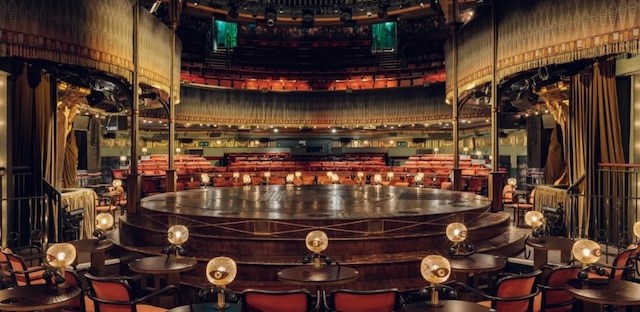
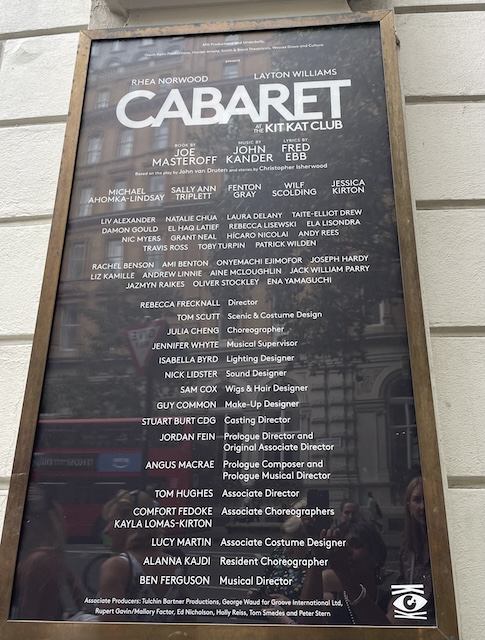
So when Anne said she had tickets to see the stage production, I was beyond excited. We went, during our recent trip to London, to the Playhouse Theatre. It’s just a few steps from Embankment station, and is a building that has had a few incarnations during its 142 year history, including, in its infancy, putting on the first successful play by George Bernard Shaw (Arms and the Man). But since 2021 it has been transformed, on a full-time basis, into the Kit Kat Club.


While we stood in a small queue waiting for the doors to open, a staff member walked up and down putting stickers on the cameras on our phones. What happens in the Kit Kat Club, apparently stays in the Kit Kat Club. Except that it does have some promotional photos online so they’ll do.
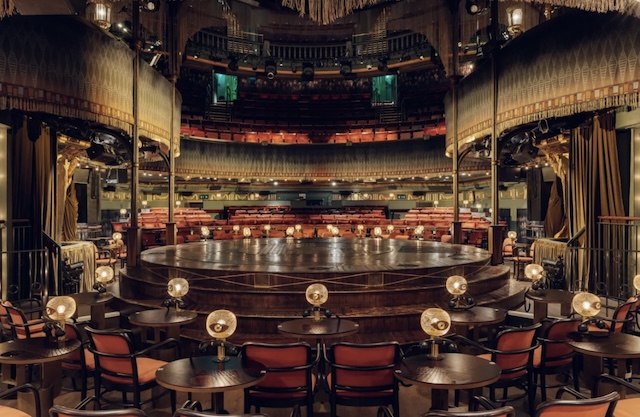
It’s a theatre in the round, so there is an audience in front of and behind the stage. I thought I’d be put off by the actors constantly turning their backs on us, but actually it seemed to work perfectly fine. Perhaps because we were so close to the stage, at the ‘tables’, where we could (and did) order champagne and charcuterie. When in Rome dear reader.
There are quite a few differences between the stage and screen versions, the most obvious is that Sally Bowles is an upper-class English woman, more akin to the woman in Isherwood’s book instead of an American. And ‘Clifford’, as opposed to Michael York’s ‘Brian’, is an American.
Our granddaughter, to her chagrin, is starting to realise that dramatic adaptions of books often veer away from the letter and the word and morph into their own creations. And so it is with Cabaret. It’s not so much adapted from, as inspired by, the original, and on top of that, it’s not as static as a book, having subsequently taken a couple of the songs written directly for the film back to the stage.
The only actor I knew before was Layton Williams because he’d been on Strictly. He’d caused a little controversy because he was already a musical theatre stalwart, so his ability to dance beforehand was already high. I loved that that was the controversy, and not that he was dancing with a male professional. It makes me think we’re moving forward until I read that many UK school libraries are removing LGBT related books. Are we progressing or swinging on a pendulum?
Sorry, a digression. Back to Layton, who plays the Emcee. We know he’s a brilliant dancer, but on top of that, his face moves from playful to naughty to sinister to stony with a mercurial ease. With him we’re dipping into the subterranean, grimy, sexually decadent world of Berlin’s in-between times. We as an audience, are asked to forget and slip for small moments into a burlesque hedonism while the fragments of Fascism coalesce around the edges, a jingoistic refrain ominously building.
The Emcee was never in Isherwood’s book but there was a whole chapter on Sally Bowles. When the musical was first conceived, Julie Andrews was considered for the part until her agent said that the role didn’t fit her ‘Mary Poppins image’. It’s a shame because I think she would have loved to play the upper-class young English woman escaping the shackles of convention to dive into Berlin’s underbelly – although Sally does end up somewhat brittle and broken on the stage, so perhaps not quite Andrews’ usual hopeful conclusion. The last main song here, ‘Cabaret‘, is a far cry from the up-tempo number in the film. It is delivered in a powerfully stilted, ironic manner by Rhea Norwood (Sally) as the Cabaret, and the Weimar Republic that was, is finished.
There aren’t too many plays that I think warrant being available all the time, and I’m not sure how long Cabaret’s residency at The Playhouse will last, but given the political state of the world as it feels like at the moment, I hope it stays here, and continues to perform this musical for a very long time to come. There is a song, in the second act, sung by Fraulein Schneider, Brian’s landlady. She had formed a romantic attachment to Herr Schultz, a Jewish man, but calls it off in the end, because of the political climate. She sings ‘What Would You Do?’, a poignant, understandable, and desperately sad song that stands for people who will do almost anything to keep a status quo and the violence from their door.
It’s heart-warming and reassuring that so many people stood up against the right-wing rioters who recently vandalised mosques and libraries (amongst other things) in the UK. And hopefully there will continue to be good people so long as there are constant reminders, like this play, of what might happen if such actions and ideology do not go unchecked, so that the pendulum doesn’t swing back.
 theleadlesspencil
Have you see Julie Andrews in Victor Victoria? I saw Cabaret for my 40th at the Lyric and loved it.
I have, many years ago now. She was more versatile than their typecasts
I Think Rhea Norwood would be Perfect choices as Rapunzel In Disney live-action ‘Tangled’
I Think Rhea Norwood would be great choices as Jean Grey In MCU