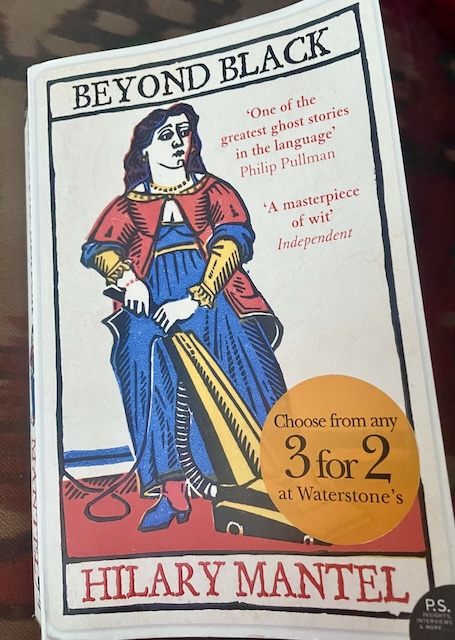
What are people looking for when they go to a medium? Is it solace, reassurance, resolution? Or just an affirmation that they’ve picked the right kitchen units?
I don’t know why it’s taken me so long to read something else by Hilary Mantel. I loved her Wolf Hall trilogy. Perhaps I didn’t want to spoil my impression of her. But this old book was on one of our shelves and, having finished something light, (Louis Theroux’s autobiography – he writes exactly as he sounds), I was ready to take the plunge again.
Alison, a jobbing medium with a damaged history, and Colette, her assistant/ manager/ saviour/ controller, travel the commuter belt towns that form anonymous satellites around London, taking gigs in bland halls and community centres. They live in an England in the late nineties and early noughts that is accelerating towards that breakup of society encouraged by Margaret Thatcher. An England that frets about homeless men in garden sheds because it affects the house prices. An England ‘gluttonous in their grief’ for Princess Diana, after having so recently seen ‘those pictures of her in the boat with Dodi, in her bikini’, and saying ‘what a slapper.’
She has the gift, but the dead do not line up in polite order to speak to their loved ones, so she still needs to dissemble sometimes, and use psychological tricks and artifice on her ‘earthside’ clients. ‘Look for a woman in middle age who isn’t wearing glasses and say: have you had your eyes tested recently?’ She homes in on the nodding heads and the yearning faces. She wears the right clothes to create the look -‘She’d got the lucky opals mail order but, if asked, she pretended they’d been left to her family by a Russian princess.’
Alison has the gift, but the dead clamour and push, and are as lost and as mundane and as vindictive as the living. The most vociferous is Morris, her ‘spirit guide’ who is pathetic and foul and repugnant. He’s our first link to Alison’s background, as he’s a ghost in her present, and also a ghost from her past. A past that is slowly and painfully, revealed as we read further.
The book is described variously as ‘darkly humorous’ and ‘excruciatingly funny’. It’s not the kind of humour that makes you laugh – I didn’t – but it’s the kind of funny that you recognise in real life. Ironic in a book that is supposedly about the supernatural.
I loved Beyond Black, but in a very different way to Wolf Hall. In those books you were there, at Thomas Cromwell’s shoulder, at all times. Up close, but also at a distance removed because the events were from so long ago. Here, the point of view darts around the characters, and very few of those characters are especially likeable examples of humanity. But I’ve lived through this time, and it feels familiar.
Alison must struggle with her medley of fiends and lost souls from ‘airside’, but she daren’t reveal to her punters what it is really like. ‘Never utter the word “death”, if she could help it.’ If she were transported to Cromwell’s time, this deception would not be as necessary, but our world is more sterile and there is more of a disconnect between the dead and the living.
What the books share is that they dig through the minutiae of daily life with a deftness. They sift through the grime and the underwear, and layer it up to build a story arc that rises out of the pieces and then forms a resolution, and I do like resolutions in books.
I’m suddenly sad that Hilary Mantel is no longer here to produce new work, because I think she is quite unique. But I’m looking forward to working my way through her back catalogue, now that I know that the Cromwell trilogy wasn’t a one off.
 theleadlesspencil
‘Beyond Black’ was also the second Hilary Mantel novel I ever read after ‘Wolf Hall’. It was some time ago now and, although I remember enjoying it in a weirdly morbid way, I know that I felt slightly disappointed that it didn’t come near the greatness of her first Booker winner. As an arch sceptic about all things supernatural (although a huge fan of ‘Dracula’ and ‘Frankenstein’), I couldn’t get past the idea that this was a satire of the (in)famous Doris Stokes, ripping off the gullibly desperate in the 1980s. That said, Mantel’s treatment of Alison’s weight and related food issues resonated strongly.
After that, I turned to ‘A Place of Greater Safety’, Mantel’s stunning re-telling of the story of the French Revolution. It’s long but worth every minute’s reading. I actually developed a crush on one of the characters, so vividly was he drawn by the genius author.
Great. I know which book of hers I’ll read next! I think if the ‘airside’ world exists, it would look a lot like she describes it.