My brother-in-law, Bhupendra, said he really didn’t want to do it. He wore a grimace on his face that seemed to be reliving a past trauma, and I began having second thoughts about pushing the subject. The concierge at the hotel, however, suggested that if we were in the 12-4pm sweet spot, we might just be okay.
We had done virtually all our travelling by car and rickshaw within Mumbai, but most people here used the trains, and I wanted to go on at least one. Bhupendra’s last experience had involved crushing queues for tickets and then half hanging out of the doorway of the carriage. At least he hadn’t had to climb on the top of the train, which is what I remember people doing when I was last in India.
The three of us, without my niece and nephew, decided to do a bit of shopping, in an area called Dadar. It was a place that if visited between those ‘quiet’ hours, was tolerable, but any later, and you all needed to hold hands so as not to lose each other. There seemed to be a theme here.
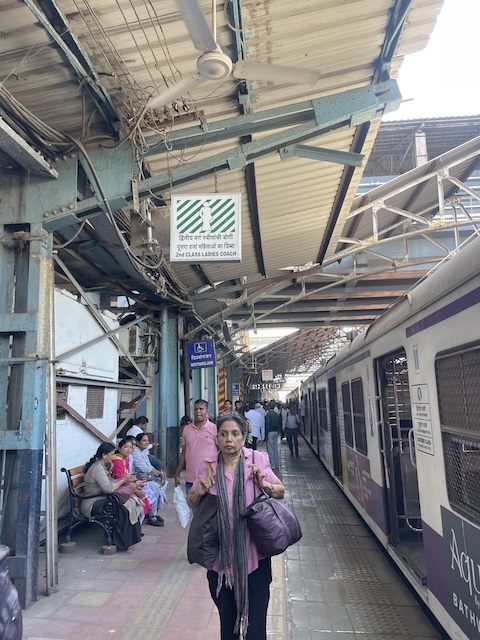
The railway station in Santa Cruz, our nearest point, isn’t geared up for people who can’t walk, but Mumbai as a whole isn’t great for disabled people. The steps up to the concourse are not all even, and there are sellers on the bridge even here. Luckily there were no queues this time, and I got three singles for fifteen rupees, around 15p. That explains why everyone uses the train. Rickshaws and Ubers are between two and four hundred rupees.
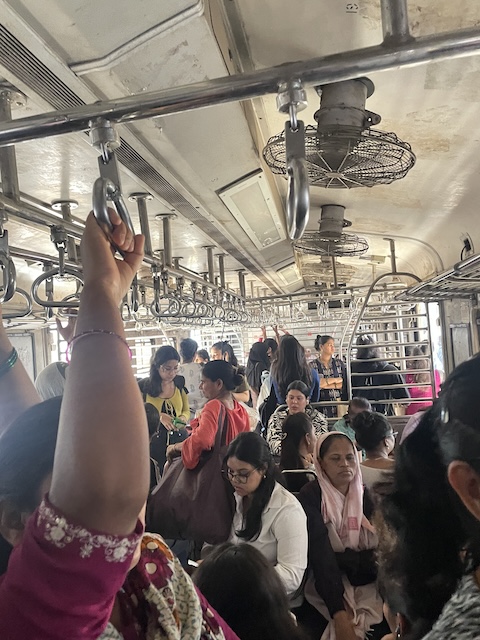
As the train pulled in, Hersha and I happened to be close to the Ladies Only carriage, so we hopped on to that one, and hoped that Bhupendra had hopped onto another carriage along the way. There are signs at the stations for where to stand for the women’s carriages, which is quite handy. Ours was full enough to require standing for a couple of stops but it wasn’t too bad.
Eventually we sat down on the metal benches in a carriage that seemed wider than English trains. The tracks in India are wider than back home, so I wasn’t imagining it. Two men got on a couple of stops in: one blind beggar and one guy shuffling on the floor on his bottom, as he didn’t have any legs. He was selling pens and packets of tissues. Evidently, there are ways and means to navigate as a disabled person that I haven’t found out.
Having got off at Dadar, we found out that Bhupendra had had his nose forced very close to someone’s armpit all the way. So, he’s still not so keen on this mode of transport, but at least I can say that while I was here, I managed to get on at least one train, two planes and many automobiles.
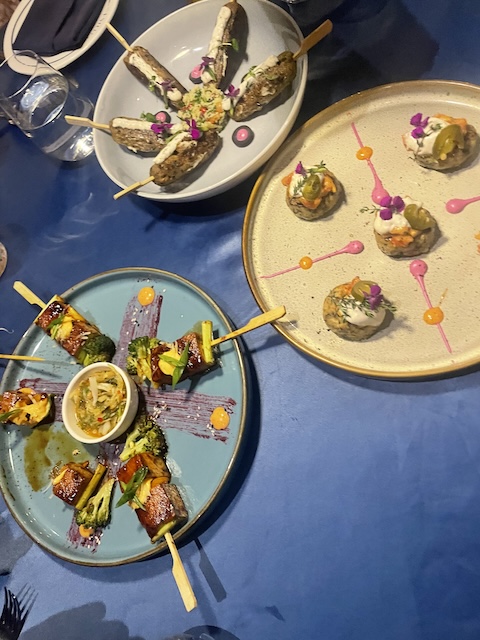
In the evening, we went to Juhu Beach again for another meal. As Maia had not got her rooftop meal at New Year, we went to Estella which had, at least a semi-outdoor feel with its lovely open view of the sea. It was such a swanky place, that I had to ask someone to show me where the lavatory doors were because they blended into the wall around them.
It was a very good night to be out because the moon and Venus (as I found out after) were bright in the night sky. It was the case in England too, as our big family WhatsApp was later flooded with photos. But ours, of course, was first, and it was interesting to see our moon at quite a different angle to home.
The downside of outdoor dining by the sea, for me at least, is that I got bitten by about twenty mosquitoes over the course of the evening. I seem to be a magnet for them, and I think the rest of the family were quite pleased considering they hardly got any bites at all.
We had dinner with one of the Pehchan team. Saarthak. He’s a young man of twenty-five, who will be coming to Nottingham this year to do his PhD. His parents are both academics and we found out during that meal that one of his grandmothers was PhD graduate too which was amazing.
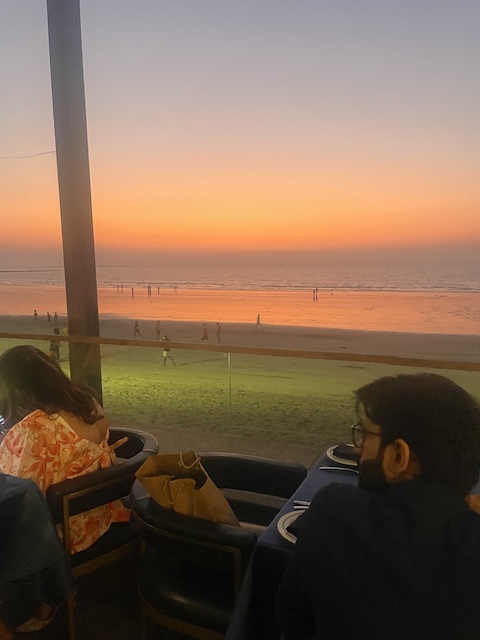

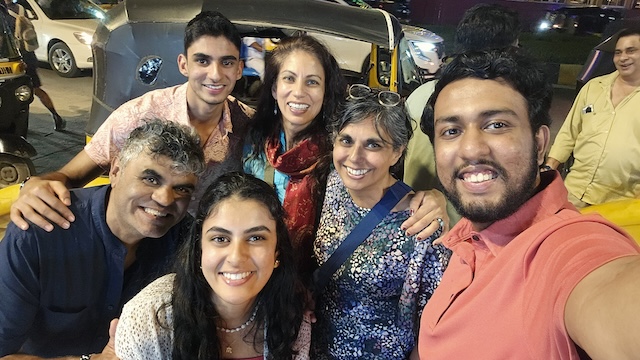
Saarthak is an inquisitive man, and on top of that, retains much of the information he finds out. His knowledge of the local historical and geo-political issues makes him sound like a man twice his age. On the other hand, he has the audacity of youth. He went to Chicago for a period with his university and had his first experience of snow. He managed to get several complete strangers in the park to join him in a snowball fight, whilst he wore a Halloween costume (it was Halloween). Under normal circumstances, he might have been locked up, but he seems to possess that joy of life that is infectious.
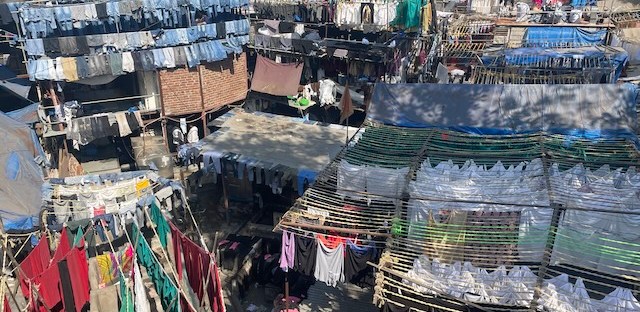
The open-air manual laundromat that is the Dhobi Ghat, has stood since 1890. There is a viewing platform now that shows you a small section of the area where they wash the clothes in the stone washing pens. Apparently, some of the wealthier ‘dhobis’ have got machines now, to do their washing for them. But there’s no need for a tumble dryer here in the hot Mumbai sun.
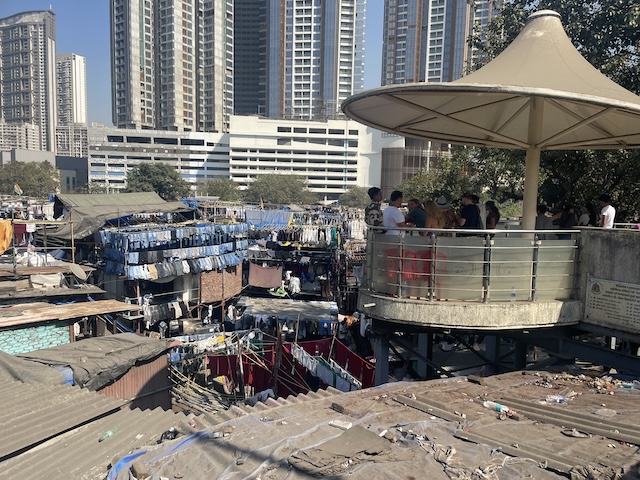
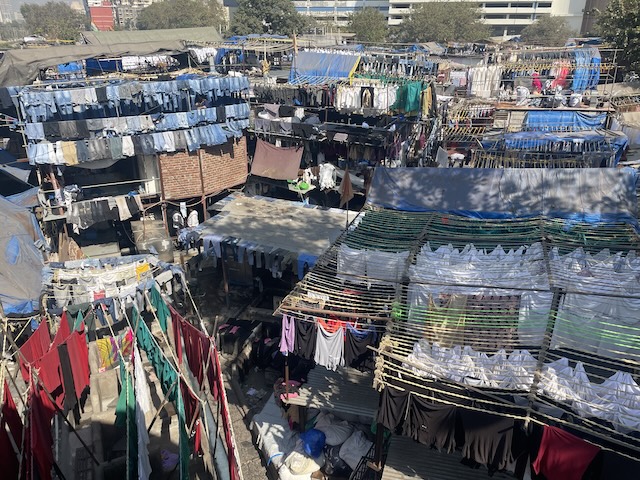
We came in the afternoon so there was very little washing being done as that happens in the early morning and all the clothes were out in quite a colour-coordinated manner. I had always assumed that the work would be done mainly by women, but it’s all men apparently.
There are no pegs that I can see, just ropes twisted over each other many times and the corners of the clothes pushed through the holes. I don’t know how some of the hotels, hospitals and private houses get their clothes back correctly given that it’s such a vast place – apparently there are around seven thousand dhobis, but somehow, they manage it.
 theleadlesspencil