
I spent yesterday morning trying to carve a path in the ice between the house and the pavement. We’ve had another flurry this morning, so I know what I’ll be doing today. A slight difference to the past two weeks but at least the activity warms me up now that I’m back home in the cold. In the meantime, there are just a couple more chapters to my India blogs to complete before I forget the heat of those days.
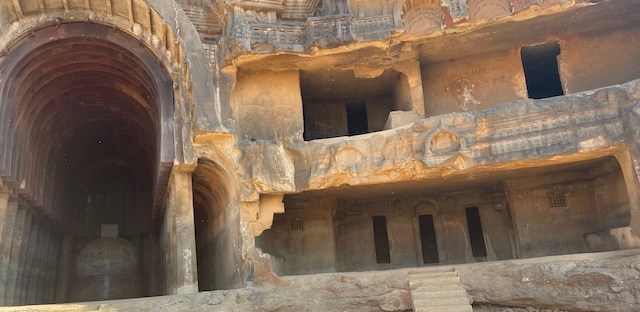
It was another earlyish start for the last big trip of our holiday. We were heading to the caves of Karla and Bhaja, in the hills some way between Mumbai and Pune. Like the statues in the Elephanta caves, these contained carvings made in basalt, incredibly hard igneous rock. These were several centuries older though and built by early Indian Buddhists.
We had various reports on what the weather would be like, with some suggestions that we’d require fleeces or cardigans, but on the morning of our trip, it was yet another thirty plus degrees, so no cardigans were needed.
Karla and Bhaja – same but different
- They both used to be Buddhist shrines and hold lodgings for travellers and merchants.
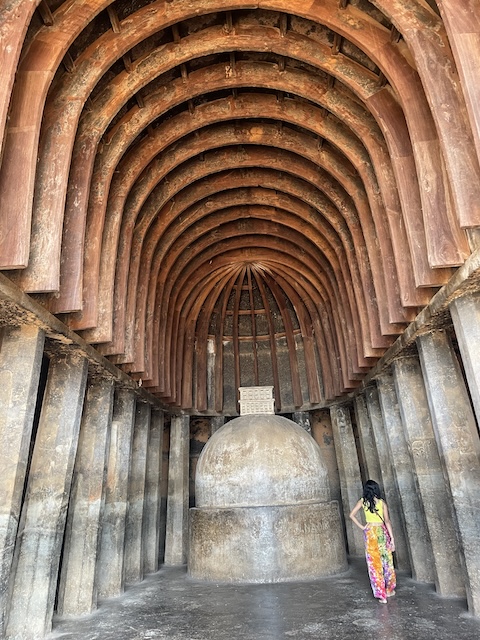
- They both contain a large ‘stupa’ (dome shaped memorial for a monk) at the far end of a ‘chaitya’ (prayer room).
- They both have a lot of steps to climb to reach the caves.
- They are part of a complex of caves in the area but are the only ones open to the public.
Karla is bigger and newer than Bhaja, finished a few decades into the Common Era, and its entrance carvings are more ornate. A Hindu temple sits in front of it, where one of the two original grand entrance pillars used to be – the Ekvira Aai Temple. According to Wikipedia, she is worshipped by the ‘Aagri and Koli’people’.
Going up to Karla is similar to the route up to the Elephanta caves. Not only because of the many steps but because of all the vendors along the way and so many of the other visitors. Most of these people, we found out later, were heading to the Hindu Temple and not the Buddhist Hall. At least the vendors’ makeshift roofs threw a little shade over us, so there was that.
As we’d climbed the steps, we’d passed a young woman who was going up on her hands and knees and had her hair loose. It was probable that she came right from the village below so doing the full five hundred steps in this way. The guide said it was some extra form of worship, possibly to pray for someone in her family or as penance. Whatever it was, it looked extremely painful and arduous, and I hope her prayers were answered or that she at least recovered.
At the top we saw a man holding a live hen by its legs. According to our guide, animal sacrifice was no longer allowed in the religious ceremonies here, but sometimes a bird was still released at a given point. The hen looked exhausted, perhaps from originally trying the scarper from the man’s clutches and seemed now resigned to whatever its fate might be.
In the high roofed chaitya, I had a feeling of awe and serenity The ceiling is many metres high, curved and ribbed with teak – apparently the original teak. Below the wooden struts, there are columns carved from the stone going the full length of the prayer hall to the stupa. Each of these had a name etched for the person who paid for its construction.
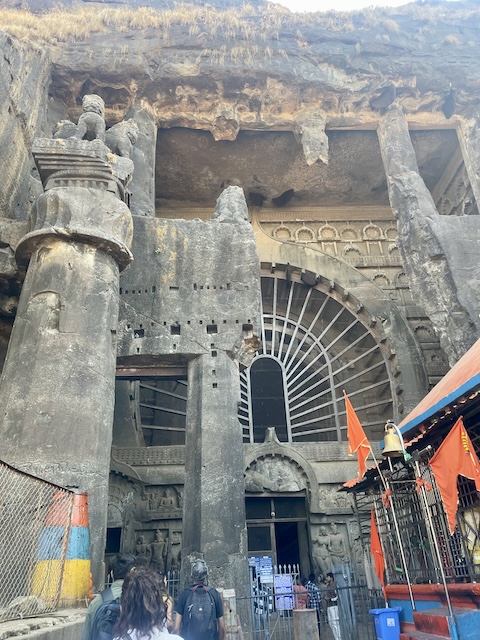

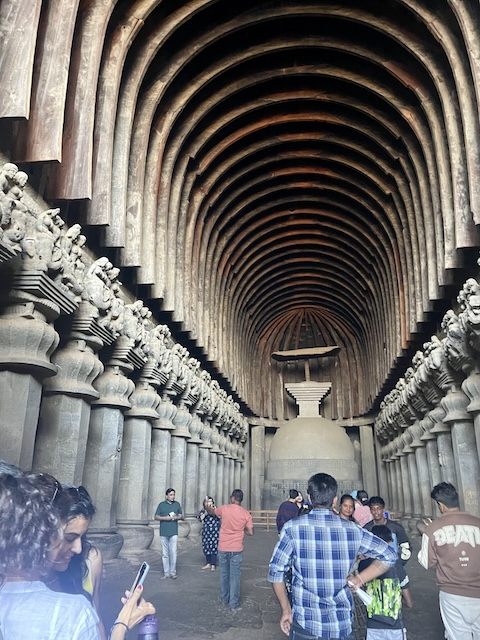

After the heat of the day, it felt pleasantly cool inside, especially as you had to take your shoes off to walk in. And it had a cathedral like calm. Some of the pillars had an extra flourish of a carving that the sponsor would have paid for to stand out perhaps amongst the others. Apparently, some of the pillars were paid for by Greek merchants, which astounded me. I think I underestimated just how much interaction between cultures there was then, especially after Alexander the Great. The wonderful thing about the stone carvings here, and especially in the very ornate entrance, is that they haven’t been used for target practice, and are, in the main, intact.
Near the main hall were several small cells and rooms that would have housed some monks and even travellers. The travellers’ rooms had a stone slab that could be used for a bed – with a bit of padding. The monks’ rooms didn’t even have that and seemed barely big enough for someone to sleep in.
Bhaja was a lot quieter and harder to reach, given that the stone steps were steeper and in the full glare of the sun. It sits to the south of the Karli village, in the opposite direction of the first caves. The chaitya here is smaller, and not as ornate. But there are other interesting sections like a room that the guide called the head monk’s chambers, but Wikipedia calls the monastery. There are also a big crowd of stupas to one side of the prayer hall, for some of the less venerated monks I guess.

The final place the guide took us was a very haphazard viewing platform that showed off the ravine in its glory. If you didn’t look at the litter strewn over the nearby edges, then the views were spectacular. In the monsoon season or just after, it was apparently much greener, and we would have seen waterfalls in many places, but even at this time, it was impressive.

Sometimes I think, when you’ve seen one cave carving, you’ve seen them all, but then I can be a real philistine sometimes. There was a whole different ambience between these two sets of caves and those on Elephanta Island, however. While the carvings at Elephanta were dynamic, sinuous representations of mythical stories, bringing the stone almost to life, these had a majestic but tranquil symmetry and simplicity. Both sets of caves are worth a visit in my opinion, but they do require a certain level of fitness to reach and a couple of bottles of water. Unlike at the island, I didn’t see any sedan chairs on offer.
 theleadlesspencil