First thing to note about being in Mumbai: Verify all information that is given as fact.
It hasn’t just happened with the staff in this hotel, but these are the two examples that come to mind straightaway.
‘Are the banks closed in this holiday period?’
‘Yes sir, they can close four or five days, you are best to go today.’
At the bank, my brother-in-law was told that they only closed for Christmas day.
‘What time do the saree shops open?’
‘Madam, you are better to go in the afternoon as they are all closed until lunchtime.’
Ours was open from nine in the morning.
Second thing to note about being in Mumbai: Addresses aren’t all that precise.
We were going to a particular shop on the recommendation of a cousin. The address was on the shop’s card, so Maia, my niece, plugged it into the Uber app. The driver took us to an area that seemed to specialise in floor tiles and there weren’t any clothes in sight but he’d taken us to the stipulated address.
Eventually, with a couple of phone calls for the shop that described their actual location in a relational manner (e.g. past the cinema, under the bridge, next to the paan kiosk) we managed to walk there about fifteen minutes later.
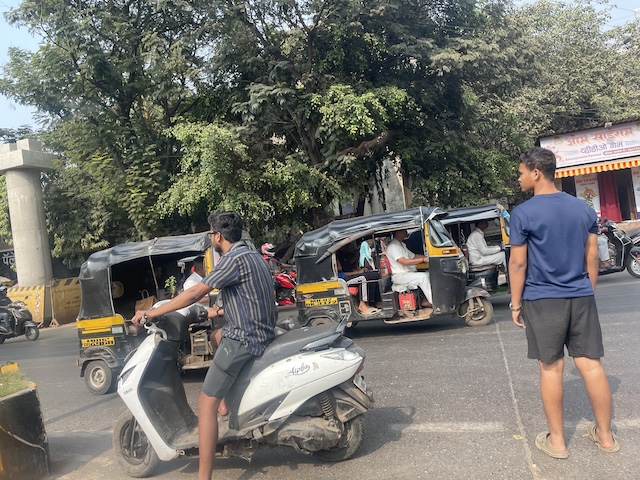
Walking is not the easiest thing to do in the suburbs of a city with over thirty million inhabitants, although loads of local people do it. Pavements might not be there. If they are then their upkeep isn’t a priority, and if vendors haven’t already grabbed prime pavement spots, the motorbikes are often parked on them. So that means a lot of walking on the roads. Which you share with a near constant commotion of cars, vans, buses, motorbikes, bicycles and other pedestrians – with the occasional man and cart thrown in for good measure.
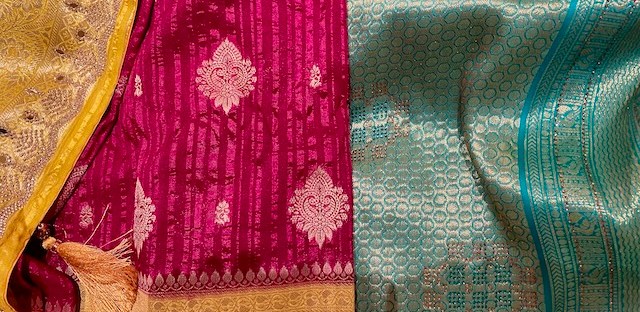
Although it is mostly women that buy sarees, it seems to be mostly men that sell them, but I rarely go shopping for sarees so I may be wrong. My sister Hersha wanted to get something for herself and Maia as they have an upcoming family wedding. There were about four men standing around the long white counter with high shelves packed with neatly folded sarees coming in all the colours of the rainbow. One man sorted the cups of tea and seats for us, two worked in tandem (or competition) to show us the wares, and the fourth guy just hung around giving his opinion now and then.
The men had a fair command of English, and my sister and I can speak some Gujarati, so our communication was adequate for the job. Gujarati isn’t the language for this area. It’s Marathi, and most people will also speak Hindi. But there are basic words in common, probably on a par with French and Italian.
It seemed a shame to mess up the display but after a few exchanged words to work out basic tastes, the guys got to it with gusto, taking saree after saree out and displaying each one with an expert flick of the wrists, along the length of the counter.
The length of a saree varies a bit, but they tend to be around nine yards long. Often there is a section on one end to cut off and make the under blouse. Then there is the long main part which wraps around you. The final section (the pallu) is often the most blingy, depending on the saree, as this will be draped in a variety of ways and be shown off the most.
The sarees kept flying out, one on top of the other. Often, we stopped them emptying the packet because the colour was completely wrong. When they were displayed, we had a good idea of definitely-maybes or an absolutely-nots.
There was no ill feeling on the part of the sellers if we wanted a saree discarded. It was just flung behind the counter to be folded up later. As the time passed, they got better at gauging our tastes. Overall, we probably went through thirty or so sarees and picked around nine to have a go with. I then video-called Anne to choose one for herself, ready for any Indian wedding we might go to.
We tried most of these nine. This is quite important, as what might look good on the counter does not necessarily look good on you. Obviously, Anne couldn’t do this bit but she does have a good eye for colour so her choice should be fine. My choices, on the other hand weren’t so hot. I was gravitating towards the bluey greens, but it’s a fine line as to whether these hues look attractive on me or make me look like an old grandma.
We didn’t need to undress or anything like that. The vendors came from around the counter and we each stood on the small step while one of them deftly wrapped a saree around using a belt to hold the middle folds. What would take me at least twenty minutes of faffing, took him three, if that. It was done well enough to see how it might look like on me for real. My first two choices were quickly kicked out when my sister Hersha and Maia both frowned. The final blue-green option made the grade, so I was able to breathe a sigh of relief. As fun as it had been, I wasn’t quite up to another round of saree slinging.

We came away with four sarees, one each for Hersha and Maia, and one each for me and Anne. It had been fun, especially as I wasn’t walking from shop to shop. We found, after much hunting again, the recommended tailors in another part of town in a kiosk in the middle of a very narrow arcade. These were all men as well. They measured us up and I gave them Anne’s measurements for the blouses to be made. Every now and then they’d send a bag of material up to a hatch above the kiosk – presumably to a room with the sewing machines, although how they get up and down from there, it is very hard to work out.
They say the tops will be done by Sunday evening which is speedy. Life doesn’t seem to stop here for weekends or holidays. Today was Christmas day, and I’d barely registered it in the hurly burly of the Mumbai streets.
 theleadlesspencil